People that have no experience in the livestock industry often wonder what we do to cattle when they are run through a chute. It doesn’t look very fun to have your head caught between two big metal slides and to be squeezed between two walls. What could we possibly be doing that would require us to catch our animals in such a way?
Many different things happen when cattle are put through a chute. Often referred to as “working” them, groups are pushed through a series of gates, alleyways, and steel walls until they are restrained by a head gate at the end of the process. It sounds stressful, and indeed it can be, but producers and workers that are properly trained can get this job done with minimal stress to the animals as well as the humans. This training is called “Beef Quality Assurance,” or “BQA.” BQA involves a combination of classroom-setting lessons with professionals and a chute-side training on how to properly handle cattle and administer shots. During the lesson, attendees are taught the best ways to raise cattle so that the animal has a high quality life, and then produces high quality, safe, tasty beef. While there is much more to it than that, you get the general idea. To learn more about BQA, visit bqa.org
So, back to what actually goes on in the chute. There are several reasons that cattle might be worked through a chute. A few of these scenarios include: to be vaccinated, due to an injury, to be loaded in a trailer to move elsewhere, or to either artificially breed or check for pregnancy. I’d like to start this off with an explanation of how a chute is used. The animal is walked up into the front of the chute, and their head is caught between two bars on the front. This keeps the animal from trying to turn around in the chute and potentially getting stuck, and creates a safer environment for the cattleman to work in, as the animal’s head is controlled. After the cow is caught, the sides are adjusted to fit the individual animal. This “squeezing” actually makes the cow feel safer and more calm, according to Dr. Temple Grandin, who revolutionized the livestock world and the ways that we handle our animals. Now, the worker is more easily able to get whatever job done, as the animal is comfortably restrained. This creates a much safer environment for both the worker and the animal.
We vaccinate cattle to ensure that they are more likely to stay healthy throughout their life, and to make sure that their meat is safe to eat. While we do care greatly about the animal while it is alive, we also take into consideration the fact that their lives serve a purpose, and ultimately that purpose is to provide food for us. Since we can’t possibly vaccinate for every possible disease, sometimes we have to administer antibiotics to an animal. Cattle also might be put in a chute to “vet” them, or treat an illness. Such illnesses include pink eye, bovine respiratory disease, hardware disease, or simply a cow that doesn’t feel good (droopy ears, runny eyes, high temperature, etc.) Once in the chute, it is easier for the vet or producer to diagnose the problem, and then carry out the necessary treatment.
Second, injuries are unfortunately a common and unavoidable thing. When cattle are out on pasture with holes, rocks, and rough terrain, injuries are inevitable. Since most cattle aren’t quite tame enough to just go out and pick up their leg to see what’s going on, they are restrained in the chute so that the injury can be better assessed and more efficiently treated. Some chutes even have the ability to be rotated horizontally, so that the cow is essentially laying on her side, in order to give you a better view of her feet. How cool is that?!
Another reason we put cattle in chutes is to sort through them and/or to load them to be moved somewhere else. While every operation is a little different, many producers will run cow/calf pairs through the chute at weaning time to do a close-up visual assessment of the animals and then to separate the cow from the calf to start the weaning process. Personally, this is what I do at home. Sorting cattle like this also makes it easier to load up a trailer. As much as I wish we were able to simply walk the cattle into a trailer in the middle of the pasture, it usually doesn’t quite work like that. It is much easier to load cattle into a trailer directly out of a chute than it is to try to corral them onto said trailer. Trust me, I’ve done it both ways.
Lastly, many breeders artificially inseminate (AI) their cows, and this requires the use of a chute for several reasons. There are countless reasons to use AI, but that is a topic for another day. (But feel free to ask questions if you have any!). In order for this to happen, the cows must be “bred” by the AI technician (fancy word for person that is acting as the bull). This is often a time-sensitive process, as the semen straw can only be exposed to air for a very short period of time. Straws are stored in liquid nitrogen to keep them viable until implanted in a cow’s reproductive tract. Cool, huh? Obviously, it’s not going to work to properly breed a cow if you’re chasing after her in the pasture, waving a tiny little straw of semen around, hoping you’ll be able to get her to stand still long enough for you to put your hand up her rectum and maneuver the insemination “gun” into position, and plant the semen in the correct place. So, once again, there is a reason we use chutes. Approximately 1-2 months after a (hopefully) successful mating, cows are often put back into the chute and preg-checked, which just means a vet or other qualified individual searches the uterus for a calf. There are 3 main ways to identify a pregnancy, or a non-pregnancy. The least common one is to draw a blood sample from the cow. A more common way is to use ultrasound (yep, just like a person!) to look for a calf in utero. This is done by a professional ultrasound technician. Perhaps the most common way to identify a pregnancy is via rectal palpation. Again, a qualified individual will feel for a calf in the uterus. It is a very cool feeling to be able to identify an unborn calf, and to know you will see that same calf running around the pasture in just a few months’ time.
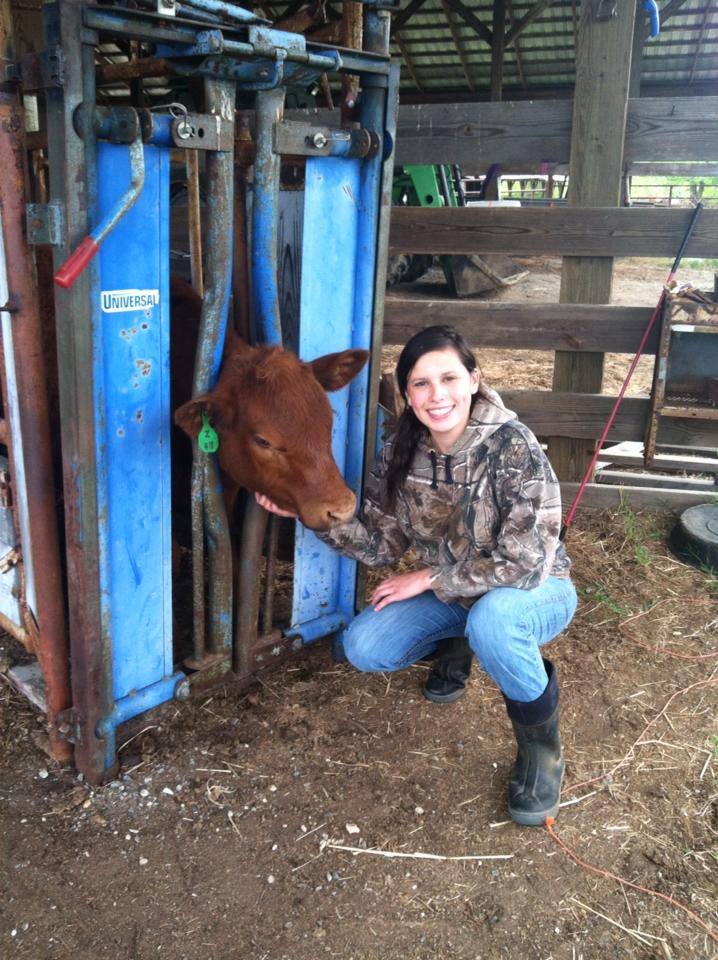
As you can see, there are many reasons producers utilize chutes to work cattle. There are even more that I have not listed; I felt that these were the most common scenarios that would be best to share with you. Feel free to ask myself or any other person experienced in the livestock field about any other questions you may have!
Until next time!

 Rachel Waggie
Very well written and easily understandable by even a novice to the cattle industry. Thanks, and I look forward to reading additional blogs by KSUB&B members.
LikeLike